
A fashion show with a difference was held in various locations in Central, Tsim Sha Tsui and Causeway Bay on Feb. 25 to showcase the talent of Filipino domestic worker Elpidia A. Malicsi.
The mobile catwalk dubbed “Sustainable Sunday Couture: Domestic Workers Upcycling Fashion” was held to show how waste products can be turned into something not only useful but also fashionable.
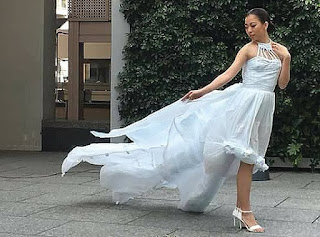 |
| Billowing white garbage bags make up a gown fit for a bride. |
The first stop for the six models dressed in Malicsi’s unique “upcycled” gowns was outside Alexandra House on Chater Road in Central, followed by the harbourfront in Tsim Sha Tsui, and finally, Paterson Street near the busy Sogo department store in Causeway Bay. The unique display attracted a lot of attention, with many passersby taking pictures of the models.
Malicsi started making a name in the Filipino community in Hong Kong when she took up a challenge from a friend to create native costumes out of recycled materials. At first she used paper, but unexpected rain during some of her shows ruined some of her creations. This made her decide to shift to using plastic sacks and garbage bags for her outfits.
 |
| Gown made of coffee sachets collected by friends. |
Her other creations were made from plastic trash bags and sacks, and styrofoam fruit cases.
“I didn’t expect that I would have this very amazing opportunity where people around me appreciate my work,” Malicsi said. “I feel extremely happy that through this I can contribute my talents and skills to save the earth and do something unique from garbage.”
Her mobile fashion show was organized by the Department of Sociology of Hongkong university, Para- site, and Voices of women, and funded by HKU’s KE (Knowledge Exchange”.
One of the organizers, Juju Chen, said the project was meant to engage the community and serve as a channel for a better understanding of the domestic helpers’ culture.
 | |
| Organizer Dr.Julie Ham (seated third from left) of Department of Sociology HKU, is jopined by Merina Su-er of Voices of Women Media, Elpidia Malicsi, Dr. Ju Chen Chen of Chinese University of Hong Kong and members of Para-site, DWEP Mentor and MKIS teams. |
Another organizer, Julie Ham, said she believes that through the project, fashion -- in particular, sustainable fashion -- could be seen as not just for the rich, but also for less well-off.
The 15 gowns used in the mobile fashion show will be on display from Mar 4-6 at the Philippine Consulate, and on Mar 18- Apr 1 at HKU’s main library.


